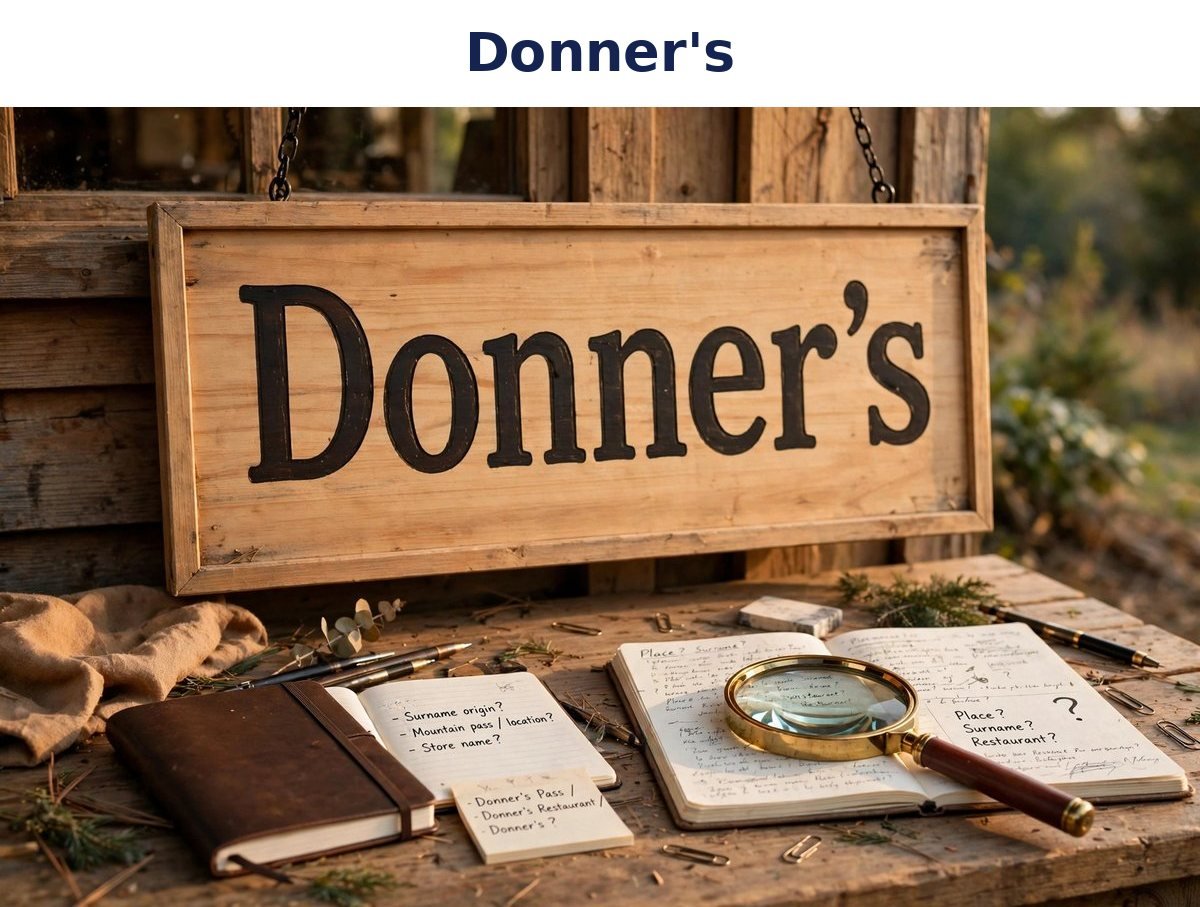

If you typed Donner’s into a search box, you probably already noticed the problem. The results do not all point to the same thing. Some look like names, some look like places, and some look like businesses. That is not a fault with your search. It is a sign that Donner’s is an ambiguous term, and the apostrophe at the end is doing a lot of quiet work.
This guide is written for that exact moment of confusion. It does not assume that you meant one particular company, shop, person, or place, because there is no single answer that fits every search. Instead, it explains what searchers most plausibly mean when they use the term, the common contexts in which it appears, and the practical steps you can use to narrow the results until you find the Donner’s you actually had in mind. By the end, you should be able to tell a surname search from a business search, a place search from a brand search, and a useful result from a lookalike that happens to share the same name.
Why Donner’s Is So Ambiguous
The main reason Donner’s is hard to pin down is that it is a possessive form. In plain English, adding an apostrophe and an s to a name usually means something belongs to that person, family, or business. Donner’s could therefore mean the shop owned by a family called Donner, the restaurant run by someone named Donner, or simply a shortened way of referring to a place or business whose full name begins with Donner.
That possessive form also makes the term flexible. People use it in conversation as shorthand. They might say they are going to Donner’s when everyone in their local area knows which shop or restaurant they mean, even though a reader in another town or country would have no way of knowing. Search engines face the same problem. They see the same short phrase from people with very different intentions, and they have to guess which meaning is most relevant for each person.
A second reason for the ambiguity is that Donner is also a surname. Surnames travel, they appear in many countries, and they are used in business names, street names, and place names. When a surname becomes part of a business name, the same name can be reused independently in different places by people who are not related to each other at all. Two shops called Donner’s in two different towns may have nothing in common except the name.
A third factor is spelling. Some people search for Donners without the apostrophe, some search for Donner, and some add extra words such as location, menu, opening hours, or contact details. Each variation can change the results, sometimes sharply. That is why a careful search for Donner’s often works better when you add one or two extra clues, rather than searching for the name on its own and hoping the right result rises to the top.
What Searchers Most Plausibly Mean
When someone searches for Donner’s, the intention usually falls into one of a few broad groups. Understanding which group you belong to is the fastest way to improve your results, because each group needs a different kind of extra information.
The first group is people looking for a specific business. They may have seen a sign, heard a recommendation, or visited a place before, and now they want its address, opening hours, menu, prices, or contact details. For these searchers, the missing piece is almost always location or type of business. A search for Donner’s on its own will not tell the search engine which town or which kind of shop you mean.
The second group is people looking for a person or a family name. They may be researching family history, trying to remember a name they heard, or looking for information about someone with the surname Donner. In this case, the possessive form may simply be the way the name appeared in a sentence, such as a reference to a book, a project, or a place associated with a person called Donner.
The third group is people looking for a place. Place names often grow out of surnames, especially where a family played a role in the early history of an area, or where a pass, park, lake, or settlement was named after someone. A search for Donner’s in this sense may really be a search for a location, a route, or a nearby attraction, rather than for a business at all.
The fourth group is people looking for a product, brand, or online presence. This is the trickiest group, because brand names and product names can be similar without being the same. A searcher may be trying to recall a brand they saw online, a channel, a store, or a service, and the only part of the name they remember clearly is Donner’s. In that case, adding a word that describes the product or service is usually more helpful than repeating the name.
Most real searches sit somewhere between these groups at first. You may know you want a shop, but not its town. You may know a town, but not whether the place is a restaurant or a store. That is normal, and it is why the rest of this guide focuses on narrowing the search step by step, rather than pretending there is one correct answer.
The Apostrophe Matters More Than It Looks
It is tempting to ignore punctuation in a search, and search engines often do ignore it, but the apostrophe in Donner’s still tells you something useful about how the term is being used. It signals possession or association. If you see Donner’s written with an apostrophe in a business sign or a web address, it is usually meant to read as the place belonging to, or associated with, Donner.
Without the apostrophe, Donners can look like a plural, a family name in its own right, or a shortened brand name. Searching for both versions can sometimes produce different results, and it is worth trying both if your first search does not help. The same is true for the singular form, Donner, which may bring up surname information, place information, or historical references that the possessive form does not.
This is also why you should be careful when copying a name from a sign, a receipt, or a conversation. A small difference in spelling can send you to a different business or a different person with a similar name. If you have a photo, a receipt, a business card, or a web address, use the exact spelling shown there before you try a looser search. Exact spelling is one of the simplest ways to cut through ambiguity.
Common Contexts Where Donner’s Appears
The table below summarises the most common contexts in a general way. It is not a list of specific businesses, and it does not claim that any one of these is the Donner’s you meant. Its purpose is to help you recognise your own context so you can add the right extra word to your search.
Context / What the searcher usually wants / Most helpful extra word: A local business — Address, hours, menu, prices, or contact details — Town or type of business. A surname or family name — Family history, biography, or a named person — First name, dates, or place. A place or location — Directions, nearby attractions, or local history — Region, state, or nearby town. A brand or online store — Products, prices, reviews, or an official site — Product type or category. A restaurant or food outlet — Menu, reviews, delivery, or booking — Cuisine, town, or dish. A service or workshop — Services offered, quotes, or opening hours — Service type and town.
Reading that table with your own search in mind can save a lot of time. If you know you want a restaurant, add the town and the word restaurant. If you know you want family history, add a first name or a place. If you know neither, start with the detail you are most sure about, even if it feels small. A single reliable clue is often enough to change the results completely.
Donner’s as a Surname
As a surname, Donner appears in different countries and language backgrounds, and the word itself is also found in German, where it relates to thunder. That does not mean every person or business with the name shares the same origin, and it does not mean a search for the surname will lead to one family. Surnames are shared by many unrelated families, and they change spelling over time, especially when families move between countries or languages.
If your search is about a surname, the most useful additions are usually a first name, a place, a profession, or a time period. A search for a surname on its own will usually return a mixture of people, places, and businesses, because search engines cannot tell whether you want a person, a place named after a person, or a business named after a person. Adding even one personal detail, such as a first name or a town, narrows the field sharply.
It is also worth remembering that older records may spell the name differently, or may use the possessive form in a sentence rather than as a formal name. For example, a historical reference might talk about a house, a farm, or a project associated with a person called Donner, and a modern reader might shorten that to Donner’s. If you are researching history, try searching for the name without the apostrophe as well, and try adding words such as history, family, or biography.
Donner’s as a Place Name
Place names are another common source of confusion. A place may be named after a person, a family, or an event, and local people may then shorten the full place name in conversation. A visitor who hears the shortened form may later search for it and struggle to find it, because maps and official listings usually use the full name.
If you think Donner’s might be a place, try to recall the wider area. Was it near mountains, a lake, a road, or a town you remember? Was it a pass, a park, a settlement, or a landmark? Adding a region, a nearby town, or a geographical feature can help a search engine move from a business listing to a map result. If you have a photo with a sign, a road name, or a landscape in the background, those details are often more useful than the name alone.
Place searches also benefit from checking maps directly. A map search for the name, combined with the area you remember, can reveal a location that a general web search buries under business listings. If the place is small or local, it may not have a large web presence at all, and a map result may be the clearest confirmation that you have found the right one.
Donner’s as a Business Name
Business names are the most likely source of duplicate results. There is nothing to stop two unrelated businesses in different towns from using the same possessive name, especially when that name comes from a common surname or a family name. A small local shop, a restaurant, a workshop, or a service provider may all use a name of this form, and none of them needs permission from the others unless a trademark or a local naming rule applies in their area.
That is why location is so important for business searches. A business search without a town is essentially asking the search engine to guess which of many similar businesses you mean, and it will usually guess based on your own location, your search history, or the popularity of the listing. That guess may be right, but it may also be a business in a completely different place with the same name.
If you are looking for a business, try to remember its type as well as its town. A restaurant, a bakery, a garage, a store, and a studio all need different extra words, and adding the right one can move the correct listing to the top. If you remember a street name, a nearby landmark, or a distinctive product or service, add that too. The more specific the detail, the less the search engine has to guess.
How to Narrow Your Search in Practice
Narrowing a search for Donner’s does not require any special skill. It mainly requires adding the one detail you are most confident about, and then checking the result carefully before you trust it. The steps below work for most ambiguous name searches, and they are especially useful when the name on its own returns a mixture of unrelated results.
- Start with the name plus the town or area, if you know it. This is the single most powerful addition for a business or place search.
- Add the type of business or place, such as restaurant, shop, store, park, or service, if you know what kind of place it is.
- Add a distinctive detail, such as a dish, a product, a service, or a nearby landmark, if you remember one.
- Try the name without the apostrophe, and then without the possessive ending, if the first search does not help.
- Check the address, phone area, or map location on the result before you assume it is the right one.
- If you have a web address, a social media handle, or a photo of a sign, search for that exact text rather than guessing.
- Save or bookmark the correct result once you find it, so you do not have to repeat the same ambiguous search later.
A useful habit is to search in layers. Begin with the broadest version that includes your strongest clue, look at the first few results, and then add another clue only if the results are still mixed. Adding too many uncertain words at once can actually make the search worse, because the search engine may treat a wrong guess as a requirement and hide the correct result. One confident clue at a time usually works better than five guesses.
It also helps to use different kinds of search when the web results are unclear. A map search is better for places and local businesses. An image search can help if you remember a sign, a logo, or a building. A social media search can help if the business is mainly active on social platforms rather than on a traditional website. None of these is a replacement for checking the result, but each one can reveal a different set of listings for the same name.
How to Verify You Have Found the Right Donner’s
Finding a result with the right name is only half the job. Because the name is shared, you also need to verify that the result matches the Donner’s you meant. This step matters most when you plan to visit, call, order, or send money, because a similar name in another town can look convincing at first glance.
Start with the address and the map location. Does the town match the place you remember or the place you need? Does the street or area look familiar? A business in the wrong town with the right name is still the wrong business, even if its website looks professional and its reviews look good.
Next, check the type of business or service. Does it offer what you expected? A restaurant result will not help if you wanted a workshop, and a store result will not help if you wanted a service. The description, the categories, and the photos on a listing usually make this clear within a few seconds, and it is worth those few seconds before you rely on the result.
Then look for a second confirming detail. That could be a phone number you recognise, a product or dish you remember, a photo of a building you have seen, or a social media page that matches what you already know. One matching detail is a good sign. Two matching details are much stronger. If you cannot find any second detail, treat the result as unconfirmed and keep searching rather than assuming it is correct.
Be especially careful with contact details and payment information. If a listing asks you to call a number, send money, or share personal details, make sure you have verified the listing through a second source, such as an official website, a map listing, or a social media page that you can cross-check. Scam listings sometimes reuse real business names, and an ambiguous name makes that easier, because a searcher may accept the first plausible result without checking.
Finally, consider whether the result is current. Businesses move, change names, close, and reopen under new management. A result that was correct a year ago may no longer be correct today. Opening hours, addresses, and phone numbers change, and older directory listings are not always updated. If the details matter, such as for a visit or an order, check the date of the listing or look for a recent update, review, or post that confirms the business is still operating at that address.
Common Mistakes When Searching for Donner’s
Several common mistakes make an ambiguous search harder than it needs to be. The first is trusting the first result without checking its location. Search engines rank results by popularity, relevance, and your own location, not by certainty that they match your intention. A popular business in another town can easily outrank a smaller local business with the same name.
The second mistake is assuming that two results with the same name must be related. They may be branches of the same business, but they may also be completely unrelated businesses that happen to share a surname-based name. Do not assume that a review, a menu, or a price from one listing applies to another listing with the same name, even if the names match exactly.
The third mistake is copying a name from memory without checking the spelling. Donner, Donners, and Donner’s can lead to different results, and a small spelling error can lead to a different surname altogether. If you have the name in writing, from a sign, a receipt, or a message, copy it exactly before you try a broader search.
The fourth mistake is adding a wrong detail and then trusting the filtered results. If you guess a town or a type of business and that guess is wrong, the search engine may hide the correct result and show you a plausible but incorrect alternative. If a narrowed search gives you nothing useful, remove the last detail you added and try a different one, rather than adding more guesses on top of it.
The fifth mistake is treating a single source as proof. A directory listing, a social media page, and a map result can all be out of date or incomplete, and they can also disagree with each other. When the details matter, cross-checking two independent sources is a simple habit that prevents most errors.
Searching With Extra Clues You Already Have
Many people searching for Donner’s actually have more clues than they realise. They may have heard the name in a conversation, seen it on a sign, or received a recommendation from a friend. Each of those situations usually comes with at least one extra detail, even if it feels unimportant at the time.
Think about where you first heard the name. Was it in a local recommendation, a travel story, a family conversation, or an online post? The source of the name often hints at the type of place. A local recommendation usually means a local business. A travel story usually means a place. A family conversation usually means a person or a family connection. An online post may include a photo, a handle, or a link that you can search for directly.
Think about what you were doing when you heard the name. Were you looking for food, a service, a shop, or directions? The task you were trying to complete is often the best extra word for your search, because it describes what you wanted from Donner’s in the first place. Searching for the name plus that task is usually more productive than searching for the name alone.
Think about any visual details you remember. A colour, a sign style, a building, a dish, or a product can all be useful, especially in an image search or a map search. Even a vague memory, such as a wooden sign or a shopfront, can help you recognise the right result when you see it, even if it does not help the search engine find it.
Finally, think about who else might know. If a friend recommended the place, ask them for the town, the street, or a link. If you saw the name online, check your browsing history, your messages, or your saved posts. A single link or address from the original source is worth far more than a dozen broad searches, because it removes the ambiguity entirely.
Frequently Asked Questions
What does Donner’s mean?
Donner’s is a possessive form based on the name Donner. In most uses, it means something associated with, owned by, or named after a person, family, or business called Donner. Because the name is shared, the exact meaning depends on the context, the location, and the type of place or business involved.
Is there only one Donner’s?
No, not in general. The name can be used independently by different businesses, places, and people in different locations, and a search for the name alone can return several unrelated results. That is why adding a town, a type of business, or another detail is usually necessary to find the specific one you meant.
How do I find the Donner’s near me?
Add your town or area to the search, along with the type of place if you know it, and then check the map location and address on the result. A map search can be especially helpful for local businesses and places, because it shows the location directly rather than relying on a web ranking.
Why do I get different results for Donner’s, Donners, and Donner?
The apostrophe and the final letter change how the term is read. Donner’s suggests possession or association, Donners can look like a plural or a family name, and Donner can bring up surname or place information. Trying each version, with the same extra clue, can reveal results that a single spelling hides.
How can I tell if a Donner’s listing is the right one?
Check the address and town first, then the type of business or place, and then look for a second confirming detail such as a product, a photo, a phone number, or a social media page you recognise. If you cannot confirm at least two details, keep searching rather than assuming the first result is correct.
What should I do if I still cannot find the right Donner’s?
Go back to the source where you first heard the name, if you can. A link, a message, a photo, a receipt, or a recommendation from the person who mentioned it will usually contain the town, the address, or the type of place. Without that clue, try a broader search with a different detail, such as a nearby landmark or the task you were trying to complete.
Conclusion
Donner’s is a useful example of how a short, familiar-looking search term can hide a lot of ambiguity. The name itself is simple, but the intention behind it can be a business, a person, a place, a brand, or simply a shortened reference to something larger. There is no single correct answer that works for every searcher, and any guide that pretended otherwise would be misleading.
The practical answer is to treat the search as a process, not a single query. Start with the name, add the detail you are most sure about, check the location and type of the result, and look for a second confirming detail before you rely on it. If the first search gives you a mixture of unrelated results, that mixture is information in itself: it tells you that you need one more clue, not that the search has failed.
Used that way, Donner’s stops being a confusing search and becomes a manageable one. You may not find the answer in the first result, but you will know how to recognise it when you see it, how to rule out lookalikes, and how to verify that the Donner’s you found is the Donner’s you meant. That careful approach takes only a few extra seconds, and it is the difference between a plausible result and the right one.
Read Also: Local SEO Service in Darbhanga: Help Nearby Customers Find Your Business