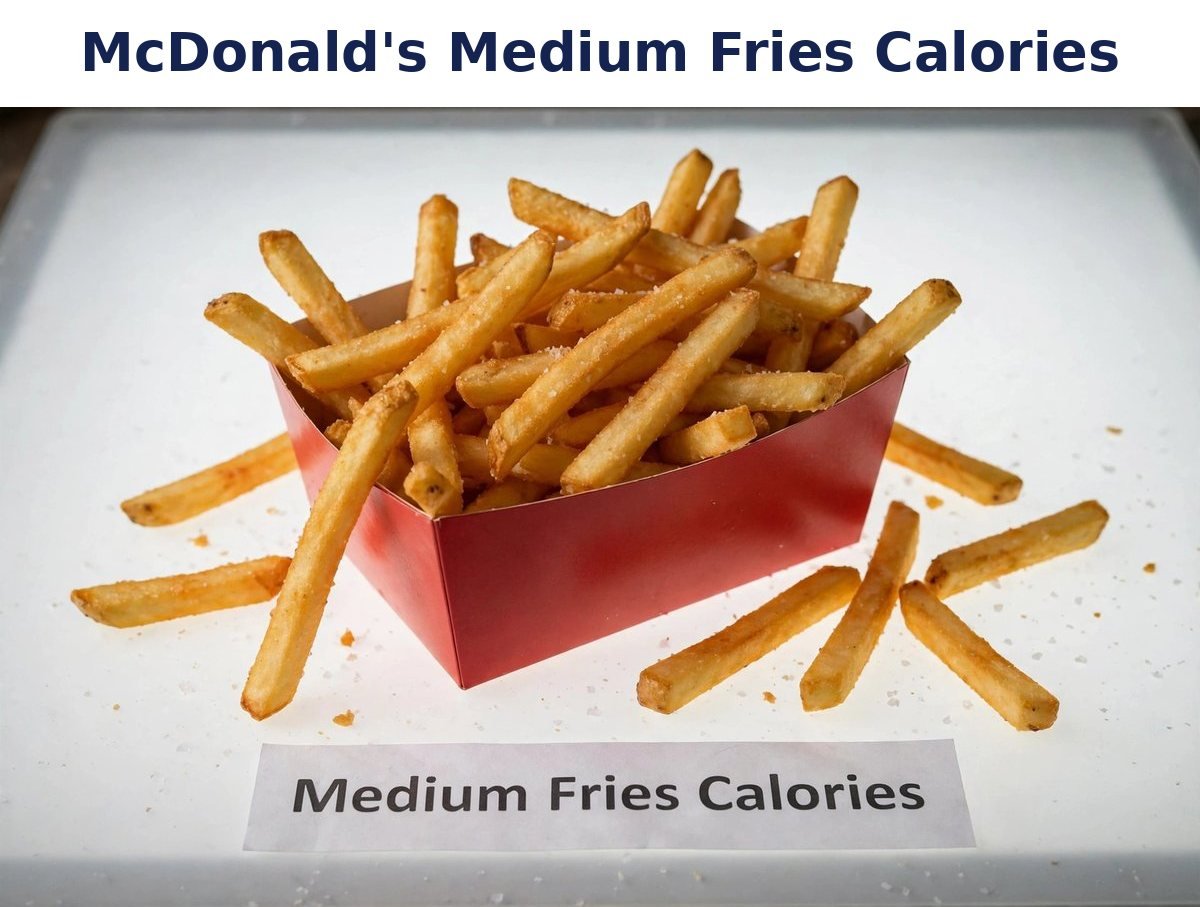

If you are checking McDonald’s medium fries calories before you order, you are probably looking for a simple number. The honest answer is a little less simple, and that is actually good news, because a single number without context can be misleading. The calorie figure for a medium fries can vary by country, by portion, and over time as recipes and serving sizes change, so the most useful answer is a qualified range plus a clear way to check the current figure where you live.
This guide gives you that range, explains why it varies, and shows how a medium fries fits into a day of eating without turning one side dish into a source of stress. It does not present one unverified number as a permanent fact, because that would be the wrong kind of helpful. Instead, it helps you understand what the number means, what can push it up or down, and what to do when you want an exact figure for today, in your country, at your local restaurant.
The Quick Answer, With the Important Qualification
For many readers, the working range for McDonald’s medium fries calories is roughly in the low to mid hundreds of calories per serving, commonly around the low-to-mid 300s in many published listings for a standard medium serving. That range is a useful starting point for planning a meal, comparing sizes, or deciding whether to share, swap, or skip the fries on a particular day.
It is not, however, a promise that every medium fries everywhere will fall on exactly the same number. Different countries use different potato varieties, oils, portion weights, and salt levels, and menus change over time. A figure that was correct in one country last year may not match the figure in another country today, and even within one country, a serving that is filled a little more generously than usual will contain a little more energy than a serving that is filled a little less generously.
That is why the best practice is to treat the range in this guide as a planning estimate, and to check McDonald’s official nutrition calculator or the nutrition information for your country when you need an exact, current figure. The official calculator is designed for exactly this purpose: it lets you select your country and your items, and it reflects the current menu and portion information for that market. If you are tracking calories closely for health reasons, that check is worth the minute it takes.
The rest of this guide explains the reasons behind the variation, so the range makes sense and you can judge other figures you see online with more confidence. If you see a single number presented as the universal answer, with no mention of country, date, or portion, treat it with caution. It may be correct for one market at one time, but it is unlikely to be correct for every reader.
Why the Number Varies by Country
The largest reason McDonald’s medium fries calories vary is that McDonald’s is not serving an identical product in every country. Menus are adapted to local tastes, local suppliers, local regulations, and local portion customs. Those adaptations are normal, and they affect nutrition in ways that are easy to overlook if you only look at the name of the item.
Potato variety and preparation can differ. The type of potato, how it is cut, how it is cooked, and what oil is used can all affect the final energy content. Oil is energy-dense, so even a small difference in how much oil the fries absorb during cooking can change the calorie figure noticeably. That does not mean one country’s fries are better or worse in any simple sense, but it does mean a figure from one market cannot be copied to another without checking.
Portion weight is another major factor. A medium is a label, not a universal weight. What counts as medium in one country may be a little larger or a little smaller than what counts as medium in another, and that difference flows straight into the calorie total. If you compare figures from two countries and they differ, portion size is often the first explanation to check, before you assume a recipe change.
Salt and seasoning also vary, although salt itself does not add calories. What salt does affect is taste and, for some people, how much they eat and how thirsty they feel afterwards. More importantly for calorie counting, different markets may offer different dips, sauces, and extras alongside fries, and those extras are where a meal’s total can rise quickly. A medium fries on its own and a medium fries with a rich dip are not the same meal, even if the fries themselves are identical.
Labelling and rounding rules differ too. Some countries require nutrition information to be shown in a particular format, some round figures, and some update their published figures at different times. Two sources can therefore show slightly different numbers for what is essentially the same serving, simply because one has rounded, updated, or measured in a different way. That is another reason to prefer the official figure for your country over a random figure copied from another market.
What Affects the Calories in One Serving
Even within a single country, a medium fries is not a laboratory-perfect portion every time. It is a fast-food serving prepared quickly, by hand, in a busy kitchen, and natural variation is part of that process. Understanding the main sources of variation helps you see why a range is more honest than a single precise-looking number.
Factors: Portion weight — A fuller carton contains more fries and more calories — Share, or ask for the standard serving if you are tracking closely. Cooking oil absorbed — More oil means more energy in the same weight of fries — Nothing practical at the counter; use the official figure as your guide. Added salt — No calories from salt itself, but it affects taste and thirst — Skip extra salt if you are watching sodium, not calories. Dips and sauces — Rich dips can add a meaningful amount of energy — Choose a lighter dip, use less, or skip it. What else is in the meal — A burger, drink, and dessert change the meal total far more than the fries alone — Look at the whole meal, not just the side dish. Country and menu version — Different portions, oils, and recipes change the base figure — Check the official calculator for your country.
The table makes an important point that is easy to miss when you focus on one item. The fries are only one part of the meal. A sugary drink, a large burger, extra cheese, or a dessert can change the total energy of the meal by far more than the difference between a slightly generous and a slightly light serving of fries. If your goal is to understand a meal, it helps to look at the whole order, not just the side dish in isolation.
That does not mean the fries figure is unimportant. For many people, fries are the part of the meal they most enjoy, and they are also the part they most often wonder about. Knowing the approximate range lets you make a decision with your eyes open, whether that decision is to enjoy the fries as they are, to share them, to choose a smaller size, or to balance the rest of the day a little differently.
How Medium Compares With Small and Large
One of the most common follow-up questions after McDonald’s medium fries calories is how medium compares with the other sizes. The general pattern is simple and reliable, even without exact numbers: a small serving contains less energy than a medium, and a large serving contains more, because the main difference is the amount of fries in the carton.
That simple pattern is more useful than it sounds, because it gives you a practical way to adjust a meal without giving up the food you enjoy. If you love fries but want a lighter meal, choosing a small instead of a medium is a straightforward reduction, and it does not require you to change the rest of your order. If you are sharing with someone, a large shared between two people can work out lighter per person than a medium each, depending on how the sharing works out in practice.
It is also worth remembering that the jump between sizes is not always proportional in the way people expect. A large is not necessarily twice a medium, and a small is not necessarily half a medium. Portion steps are set by the menu, not by a simple formula, so the only reliable way to compare sizes in your country is to check the official nutrition information for all three sizes together. That comparison will show you the actual steps for your market, and it will help you decide whether the extra fries in the next size up are worth it to you on that day.
For everyday decisions, a useful rule is to choose the size that matches your appetite and the rest of your meal, rather than defaulting to medium out of habit. If you are having a filling main course and a drink, a small fries may be plenty. If fries are the main attraction and the rest of the meal is light, a medium may fit comfortably. The size label matters less than the total meal and how you feel afterwards.
Calories Are Only Part of the Nutrition Picture
Calories tell you about energy, but they do not tell you the whole story about a food. Medium fries are mainly carbohydrate and fat, with a modest amount of protein, and they are usually salted. That combination is part of why they taste so satisfying: the starch gives energy, the fat carries flavour and crispness, and the salt sharpens the taste. It is also why fries are best understood as an occasional side dish for most people, rather than as a main source of nutrition.
From a broader nutrition point of view, fries are not a strong source of fibre, vitamins, or minerals compared with foods such as vegetables, fruit, whole grains, or lean protein. That does not make them forbidden or harmful in isolation, and it does not mean a single serving ruins a day of eating. It simply means that if you eat fries often, it is worth thinking about what else is on the plate and in the day, so the overall pattern still includes plenty of more nutrient-dense foods.
Sodium is another factor worth noting, especially if you eat out often or if you are watching your salt intake for health reasons. Salted fries contribute sodium, and the total sodium in a meal can rise quickly when fries are combined with a burger, sauces, and a soft drink. Again, the official nutrition information for your country is the best source for the current sodium figure, because it varies with portion and recipe just as calories do.
None of this needs to turn a simple side dish into a complicated calculation. The practical takeaway is balance over time. A medium fries enjoyed as part of a varied day, alongside vegetables, protein, and water, sits very differently from a pattern where fried sides, sugary drinks, and large portions are the norm every day. The difference is the pattern, not the single serving.
Fitting Medium Fries Into Your Day
If you are tracking calories, the easiest way to fit McDonald’s medium fries calories into your day is to use the qualified range as a planning figure, and then to look at the day as a whole rather than obsessing over the exact number for one item. Most people find it helpful to think in terms of the meal, the day, and the week, in that order.
At the meal level, ask what else you are ordering. A lighter main course, water instead of a sugary drink, or a salad or fruit side on another occasion can balance a medium fries without making the meal feel restrictive. Sharing fries with someone else is another simple option that many people enjoy more than skipping fries altogether, because it keeps the taste and the experience while reducing the portion.
At the day level, think about what you have already eaten and what you plan to eat later. If the rest of the day is relatively light, a medium fries fits easily. If the rest of the day is already rich, you might choose a smaller size, share, or save the fries for another day. This is not about strict rules. It is about making a choice that feels sustainable, rather than a choice that feels like punishment and is abandoned the next day.
At the week level, frequency matters more than any single serving. Fries once in a while, as part of a varied diet, are a very different pattern from fries every day as a default side. If you find yourself ordering fries automatically, it can help to pause and ask whether you actually want them that day, or whether you are ordering them out of habit. That small pause often leads to a more satisfying choice, whether that choice is to enjoy the fries fully or to choose something else.
It also helps to eat mindfully when you do order fries. Eating slowly, noticing the taste and texture, and stopping when you feel satisfied rather than when the carton is empty can make a medium serving feel more satisfying than a larger serving eaten quickly and without attention. Portion satisfaction is not only about the number of fries. It is also about attention, pace, and the rest of the meal.
Healthier Ways to Enjoy Fries
You do not need to give up fries to eat in a way that supports your health, and you do not need to turn every order into a test of willpower. A few practical swaps and habits can keep the enjoyment while softening the overall impact of the meal.
- Choose the size that matches your hunger, not the largest size available. A small or a shared medium often satisfies the craving just as well as a full medium.
- Share fries when you are eating with others. Sharing is social, it reduces waste, and it naturally controls the portion without feeling restrictive.
- Skip or limit rich dips and extra sauces, or use a smaller amount. Sauces can add energy quickly, and they are often the easiest part of the meal to reduce.
- Pair fries with water rather than a sugary drink. The drink choice can change the meal total by more than the difference between fry sizes.
- Balance the rest of the day with vegetables, fruit, whole grains, and lean protein, rather than trying to undo one meal with a strict restriction later.
- Eat fries as an occasional treat if that suits your goals, rather than as an automatic side with every fast-food meal.
- Check the official nutrition calculator for your country before you order if you are tracking closely, so you are working with the current figure rather than a remembered one.
These ideas work because they are flexible. You can use one of them, several of them, or none of them on a given day, depending on what matters to you at that moment. The goal is not perfection. It is a pattern of eating that you can maintain, enjoy, and adjust over time without feeling that one side dish defines your health.
If you have a specific health condition, dietary restriction, or nutrition goal, the general advice in this guide is not a substitute for personalised advice. A doctor, dietitian, or other qualified professional can help you interpret nutrition figures in the context of your own health, medication, activity level, and overall diet, and that personalised guidance will always be more useful than a general range.
How to Check the Current Official Figure
Because McDonald’s medium fries calories vary by country and change over time, the most reliable step is to check the official source for your market. The process is straightforward, and it takes only a minute once you know where to look.
First, make sure you are looking at the nutrition information for your own country, not for another market that happens to appear first in a search. Country selection matters more than most people realise, and it is the most common reason why two online figures disagree. If a site does not clearly state which country its figures apply to, treat those figures as a general guide only.
Second, use the official nutrition calculator if one is available for your country. Select the medium fries item, and check whether the calculator lets you add sauces, drinks, and main courses as well. Looking at the whole meal in the calculator gives you a much clearer picture than looking at the fries alone, and it can reveal where the largest contributions to the total are coming from.
Third, note the date or version of the information if it is shown. Menus change, and a figure from an older menu may no longer apply. If you are saving a figure for future reference, save the country and the date alongside it, so you can tell later whether it is still current.
Fourth, compare like with like. Make sure you are comparing a medium with a medium, a standard serving with a standard serving, and a plain serving with a plain serving, without sauces or extras included in one figure and not in the other. Many apparent disagreements disappear once you check whether sauces, portion differences, or country differences explain them.
Finally, if you cannot find an official figure for your country, use the qualified range in this guide as a planning estimate, and be cautious about any single number you find on an unofficial site. An unofficial figure may be outdated, may come from another country, or may include extras that are not part of a standard serving. When in doubt, the range plus a check of the official source is safer than a precise-looking number from an unknown source.
Frequently Asked Questions
How many calories are in McDonald’s medium fries?
A useful planning range is roughly in the low-to-mid 300s in many published listings for a standard medium serving, but the exact figure varies by country, portion, and menu version. For an exact, current figure, check McDonald’s official nutrition calculator for your country before you order.
Why do different websites show different numbers for medium fries?
Different websites may use figures from different countries, different years, different portion weights, or different rounding methods, and some may include sauces or extras while others do not. Country and portion differences explain most disagreements, which is why the official figure for your market is the best reference.
Are medium fries a lot more calories than small fries?
A medium generally contains more calories than a small because it contains more fries, and a large generally contains more than a medium, but the steps between sizes are set by the menu in each country and are not always proportional. Checking the official figures for all three sizes together will show the actual steps for your market.
Do sauces and dips change the total much?
Yes, they can. A plain medium fries and the same fries with a rich dip are not the same in energy terms, and the dip can add a meaningful amount to the meal total. If you are tracking calories, either check the dip in the official calculator as well, choose a lighter option, or use a smaller amount.
Is it okay to eat medium fries if I am watching my weight?
For most people, an occasional medium fries can fit into a balanced pattern of eating, especially if the rest of the meal and the rest of the day are also considered. Frequency, portion size, drink choice, and overall pattern matter more than any single serving, and personalised advice from a qualified professional is best if you have specific health goals.
Where can I find the official calories for my country?
Use McDonald’s official nutrition calculator or nutrition information for your country, making sure the country selection matches where you are ordering. That source reflects the current menu and portion information for your market, whereas figures copied from other countries or older menus may no longer apply.
Conclusion
McDonald’s medium fries calories are best understood as a qualified range, not as a single permanent number. A planning figure in the low-to-mid 300s is useful for many readers, but it should always come with the reminder that country, portion, recipe, and menu changes can move the exact figure, and that the official nutrition calculator for your country is the right place to confirm it.
That qualification does not make the answer less useful. It makes it more honest, and it helps you make better decisions. When you know why figures vary, you can compare sizes sensibly, judge online numbers with confidence, and look at the whole meal rather than fixating on one side dish. You can enjoy fries when you want them, share them when that suits you better, choose a smaller size when the rest of the meal is filling, and balance the day without turning a simple order into a source of stress.
The simplest habit to take away from this guide is also the most reliable one: use the range for planning, check the official figure when you need precision, and let the overall pattern of your eating, not a single serving, guide your choices. With that approach, a medium fries stays what it should be — an enjoyable part of a meal, understood clearly, and chosen on purpose.
Read Also: Donner’s (2026 Guide)